Putumayo District
The Power of the DogPutumayo District is a southern Colombian region bordering Ecuador, where jungle terrain, limited roads, and competing armed groups shape both daily life and the international campaign against cocaine. In the novel, it becomes a place where the costs of that campaign are visible not only in coca fields but also in the lives of the campesinos who cultivate them.
Setting and Access
The narrative locates Putumayo District in southern Colombia and follows the Putumayo River near Puerto Asís, a town close to the Ecuadorian border. The area has few roads; long, narrow canoes carry ordinary goods such as plantains and firewood. This geography makes the river a practical route through the region and places the surrounding communities at a distance from the institutions directing policy from abroad.
In 1998, Art Keller travels to the district on an information-gathering mission for the Vertical Committee. He is meant to determine whether the Drug Enforcement Administration and the Central Intelligence Agency are giving Congress a consistent account as the White House seeks support for Plan Colombia. The proposed $1.7 billion aid package would fund defoliants, airplanes, and helicopters intended to destroy coca at its source.
Coca Cultivation and Eradication
The district’s coca economy differs from the large estates Art associates with Sinaloa. Here, many growers are small campesinos cultivating an acre or two rather than drug lords managing thousands of acres. The FARC taxes coca production in territory it controls, while the AUC collects taxes in areas under its authority. Farmers caught in territory claimed by both sides can be taxed twice.
Art watches planes spray the fields and questions the official presentation of the resulting damage as a counter-narcotics success. He presses his hosts about whether the defoliant harms food crops as well as coca, pointing to fields that appear to have held maize and asking what residents will eat if their crops are destroyed. He also challenges the spraying altitude: Monsanto’s specifications, he notes, do not recommend spraying from above ten feet, while the planes operate much higher. Wind, he warns, can carry the chemical onto neighboring crops. The intervention intended to eliminate coca thus threatens the food supply of the same poor households who grow it.
Armed Violence and Civilian Exposure
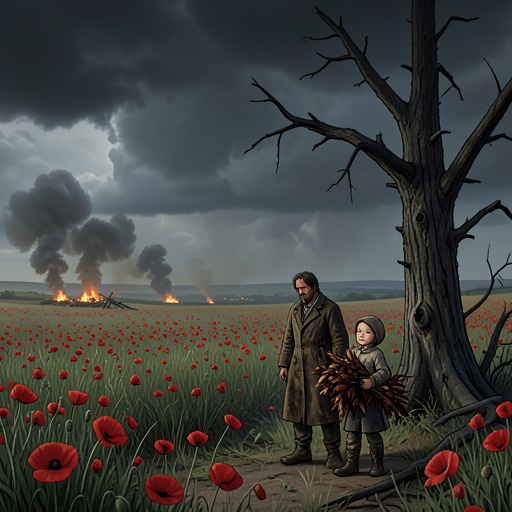
The district is also presented through the violence inflicted on villages by armed groups. After a village massacre, Art encounters the aftermath and asks whether guerrillas were responsible. A masked man says the AUC carried out the attack: its members killed young men, raped women, confined survivors in a barn and set it on fire, then killed victims at a bridge and cast their bodies into the river as a warning to communities downstream. The account makes the river, a route of transport and a defining feature of the region, part of a landscape through which violence is made visible to others.
Javier, Art’s young soldier escort, explains why he and the others brought Art to see what had happened: they hoped he would return to the United States and tell the truth, so that Americans might understand what their money and soldiers were supporting. His appeal connects local testimony to the distant congressional debate over aid, and contrasts the policy’s language of eradication with the experience of civilians living amid armed-group violence.
Narrative Significance
Putumayo District brings the consequences of Plan Colombia into the same frame as its stated objective. The coca fields are not simply a target to be destroyed: they are also part of a smallholder economy burdened by taxation from rival armed groups, while aerial eradication risks damaging food crops. The massacre adds a distinct form of civilian harm, one that cannot be reduced to the destruction of coca.
Art arrives to reconcile the accounts of U.S. agencies and support a policy debate, but the district confronts him with the people and consequences those accounts may leave out. Its remote terrain and limited roads sharpen the distance between decisions made in Washington and the communities exposed to spraying and violence. Putumayo therefore functions as a ground-level test of a national strategy: what is described as a campaign against cocaine is experienced locally through threatened livelihoods, coercive taxation, and attacks on civilians.